


Winter can feel like a fallow time in the garden, but for the observant woodland gardener it is a season of quiet revelation. Without the distraction of leaves, the true architecture of our native trees comes into sharp focus. Buds, bark, and the way twigs arrange themselves along a branch become a language you can learn to read. All you need is a little patience, a warm coat, and a hand lens in your pocket. This guide will help you identify common British trees during the colder months, turning a brisk walk into a treasure hunt.
Why Winter is the Best Time to Learn Tree Identification
When leaves have fallen, you are forced to look at features that remain constant. Summer identification often relies on leaf shape, but winter asks you to examine buds, bark, and twig arrangement. These characteristics are just as reliable, and often more so, because they do not change with the seasons. A hand lens—a simple 10x magnifier—reveals a hidden world of tiny scales, hairs, and pores that make identification precise and satisfying. Once you start noticing these details, you will never see a bare tree as simply "a tree" again.
Buds: The Compass of the Winter Twig
Buds are the most dependable clue in winter. Look first at their arrangement along the twig. Some trees hold buds in opposite pairs, directly across from one another. Others alternate, staggered along the stem. This single distinction narrows your options dramatically.
Next, examine the bud itself. Is it large and sticky, like the horse chestnut's glossy, resinous bud? Is it jet black and velvety, as on the ash? Oak buds are clustered at the twig tip, often reddish-brown and scaly. Beech buds are long, slender, and sharply pointed, like tiny cigars. Hazel buds are soft, greenish-brown, and almost downy. Use your hand lens to see whether the bud scales overlap in a particular pattern, or whether the bud sits on a small stalk. A terminal bud—the one at the very end of the twig—is often larger and more distinctive than the side buds, so always check it first.
Bark: Reading the Skin of the Tree
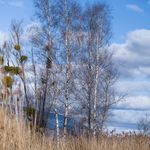
Bark changes with age, so note whether you are looking at a young sapling or a mature specimen. Young oak bark is smooth and grey-green, while mature oak develops deep, rugged fissures. Ash bark is pale grey and smooth when young, later forming diamond-shaped ridges. Beech bark remains smooth and elephant-grey throughout its life, often with a subtle wave pattern. Silver birch is unmistakable with its white, peeling papery layers, punctuated by dark horizontal lenticels. Wild cherry also has prominent horizontal lenticels, but its bark is reddish-brown and often peels in curling strips.
Look at the base of the tree too. Elder often has corky, fissured bark with a spongy texture. A hand lens will show you the tiny pores—lenticels—that allow the tree to breathe. These are especially visible on young, smooth-barked species like birch and cherry.
Twig Arrangement: Opposite or Alternate?
This is the golden rule of winter tree identification. Pick a twig and look at where the buds sit. If they are in pairs, one on each side of the twig at the same level, the arrangement is opposite. Common British trees with opposite buds include ash, sycamore, field maple, horse chestnut, and elder. If the buds are staggered, alternating left and right along the stem, the arrangement is alternate. This includes oak, beech, birch, hazel, willow, and hawthorn. Once you know this, you have halved the possibilities. Remember that the very tip of the twig may have a single terminal bud, which does not follow the pattern—so always look a little further down the stem.
The Hand Lens: A Small Tool with a Big Payoff
A hand lens is the winter identifier's secret weapon. It costs very little and slips into a coat pocket. Use it to inspect bud scales, count the number of scales on a bud, or see whether a bud is hairy or smooth. It will also reveal the tiny lenticels on bark and the delicate hairs on a twig's surface. Hold the lens close to your eye, then bring the twig towards it until the detail snaps into focus. Practise on a familiar tree first—ash is a good starting point because its black buds are so distinctive. With a lens, you will spot differences you would otherwise miss, such as the fine white hairs on a hazel twig or the resin dots on a horse chestnut bud.
A Winter Walk in Practice
Putting it all together is simply a matter of order. When you meet an unknown tree, follow these steps:
- Step one: Check twig arrangement. Opposite or alternate? This is your first big clue.
- Step two: Examine the buds. Note their colour, shape, size, and whether they are sticky, hairy, or smooth. Use your hand lens for detail.
- Step three: Look at the bark. Is it smooth, fissured, peeling, or ridged? Consider the age of the tree.
- Step four: Cross-reference. For example, opposite black buds and pale grey bark point to ash. Alternate clustered buds with rugged bark point to oak. Alternate long, pointed buds on smooth grey bark point to beech.
Start with a few common natives: ash, oak, beech, hazel, and birch. Each has a distinctive winter signature. Ash has opposite, jet-black buds. Oak has alternate, clustered reddish-brown buds and often a few dead leaves still clinging. Beech has alternate, slender, sharp buds and smooth grey bark. Hazel has alternate, soft, greenish buds and often dangling catkins from mid-winter. Birch has alternate, small, pointed buds and white peeling bark. As you gain confidence, you will begin to recognise trees at a glance, even in the depths of January. Winter woodland gardening is not just about pruning and planning—it is about deepening your relationship with the trees themselves. So wrap up warm, take your lens, and step outside. The bare branches are waiting to tell you their names.



John Doe
14 January, 2022Having no content in post should have adverse..
Chauffina Carr
10 April, 2022We use these tests all time! Killer stuff!
Jim Séchen
16 July, 2022Thanks for all the comments, everyone!